

Sustainable aviation fuel (SAF) has become one of the most urgent priorities in commercial aviation, and the scale of the challenge explains exactly why. Aviation accounts for approximately 2–3% of global carbon dioxide emissions, and demand for air transportation is projected to double by 2050. Unlike ground vehicles, aircraft can’t simply swap in a battery, they rely on dense, energy-rich liquid fuel to generate the thrust needed for flight. SAF represents the most viable near-term solution for reducing the aviation industry’s carbon footprint without waiting for an entirely new generation of aircraft.
Whether your interest is in aviation operations, sustainability policy, or fuel supply chains, understanding SAF means understanding where the industry is headed. Programs like Everglades University’s Master of Science in Aviation Science, Bachelor of Science Degree with a Major in Aviation/Aerospace, and Bachelor of Science Degree with a Major in Sustainability are designed to equip students with the foundational knowledge needed to work in fields directly shaped by this transition.
What Is Sustainable Aviation Fuel?
Sustainable aviation fuel is jet fuel produced from renewable feedstocks, such as used cooking oil, agricultural waste, and municipal solid waste, rather than from crude oil or other fossil fuels. The defining feature of SAF is that it functions as a drop-in fuel: it can be used in existing aircraft engines and distributed through existing fuel systems without requiring modifications to planes, airports, or ground infrastructure.
SAF isn’t a single product. It’s a category of fuels produced through different pathways and from various feedstocks, united by their significantly lower lifecycle carbon emissions compared to conventional jet fuel. Eleven SAF production pathways are currently certified under ASTM international standards, giving producers flexibility in how and where they source raw materials.
The term “sustainable” in sustainable aviation fuel refers to the feedstock and production process, not just the combustion chemistry. Because the carbon released when SAF burns comes from feedstocks that recently absorbed it from the atmosphere, rather than from ancient underground reserves, the net contribution to global carbon emissions is dramatically lower.
SAF Compared to Conventional Aviation Fuel and Fossil Fuels

Sustainable aviation fuel (SAF) has become one of the most urgent priorities in commercial aviation, and the scale of the challenge explains exactly why. Aviation accounts for approximately 2–3% of global carbon dioxide emissions, and demand for air transportation is projected to double by 2050. Unlike ground vehicles, aircraft can’t simply swap in a battery, they rely on dense, energy-rich liquid fuel to generate the thrust needed for flight. SAF represents the most viable near-term solution for reducing the aviation industry’s carbon footprint without waiting for an entirely new generation of aircraft.
Whether your interest is in aviation operations, sustainability policy, or fuel supply chains, understanding SAF means understanding where the industry is headed. Programs like Everglades University’s Master of Science in Aviation Science, Bachelor of Science Degree with a Major in Aviation/Aerospace, and Bachelor of Science Degree with a Major in Sustainability are designed to equip students with the foundational knowledge needed to work in fields directly shaped by this transition.
What Is Sustainable Aviation Fuel?
Sustainable aviation fuel is jet fuel produced from renewable feedstocks, such as used cooking oil, agricultural waste, and municipal solid waste, rather than from crude oil or other fossil fuels. The defining feature of SAF is that it functions as a drop-in fuel: it can be used in existing aircraft engines and distributed through existing fuel systems without requiring modifications to planes, airports, or ground infrastructure.
SAF isn’t a single product. It’s a category of fuels produced through different pathways and from various feedstocks, united by their significantly lower lifecycle carbon emissions compared to conventional jet fuel. Eleven SAF production pathways are currently certified under ASTM international standards, giving producers flexibility in how and where they source raw materials.
The term “sustainable” in sustainable aviation fuel refers to the feedstock and production process, not just the combustion chemistry. Because the carbon released when SAF burns comes from feedstocks that recently absorbed it from the atmosphere, rather than from ancient underground reserves, the net contribution to global carbon emissions is dramatically lower.
SAF Compared to Conventional Aviation Fuel and Fossil Fuels
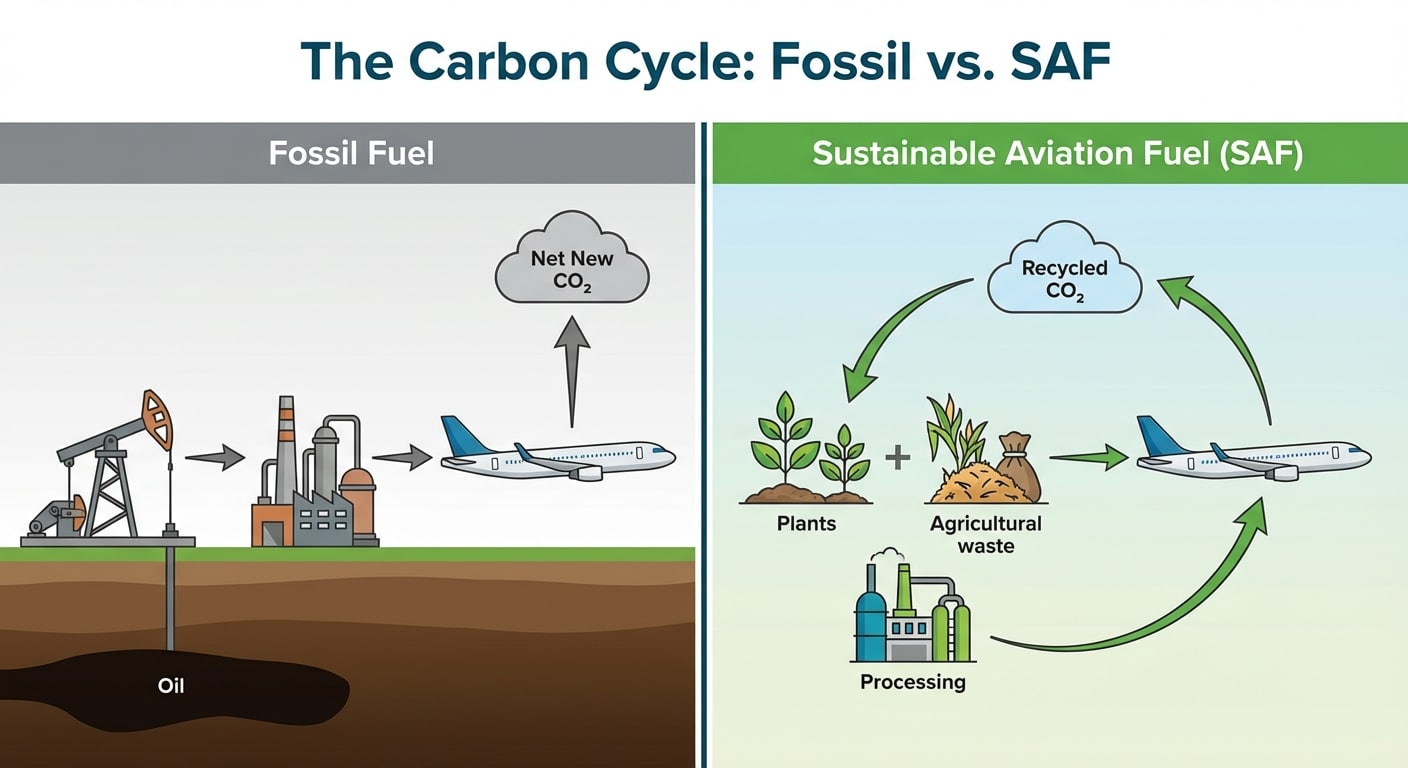
The fundamental difference between SAF and fossil jet fuel comes down to where the carbon originates. Traditional jet fuel is refined from crude oil, a fossil fuel formed over millions of years. When it burns, it releases carbon dioxide that has been locked underground for geological timescales, adding net new carbon to the atmosphere.
Unlike traditional jet fuel, SAF is produced from feedstocks that are part of the active carbon cycle. Cooking oil, crop residues, and forestry waste all absorbed atmospheric CO₂ during their growth or production. When SAF burns, it re-releases that same carbon, making the net addition to global carbon emissions far lower. When you run the full lifecycle carbon emissions accounting, SAF compared to conventional jet fuel can show reductions of up to 80% depending on the feedstock and production method used.
Beyond carbon, SAF also produces fewer harmful pollutants than conventional jet fuel. Because it contains lower concentrations of sulfur and aromatic compounds, SAF combustion generates less soot and fewer sulfur oxides, both of which contribute to local air quality problems around airports. This makes SAF a meaningful improvement for communities near major aviation hubs, not just for the atmosphere at altitude.
There’s also a practical advantage that separates SAF from other alternative fuels being explored for aviation. Hydrogen-powered aircraft are years away from commercial flight, and battery-electric aviation is currently limited to small, short-range aircraft. SAF blends with petroleum-based aviation fuel under current ASTM standards and works in aircraft engines already in service today, making it the only scalable, near-term aviation decarbonization tool available to the industry.
Lifecycle Carbon Emissions: The Environmental Case for SAF
Lifecycle emissions accounting looks at carbon not just at the point of combustion, but across the entire chain: growing or collecting the feedstock, processing it into fuel, transporting it, and burning it in an aircraft engine. When applied to fossil jet fuel, this full-cycle accounting reveals a high carbon intensity because every stage involves releasing stored carbon with no natural offset.
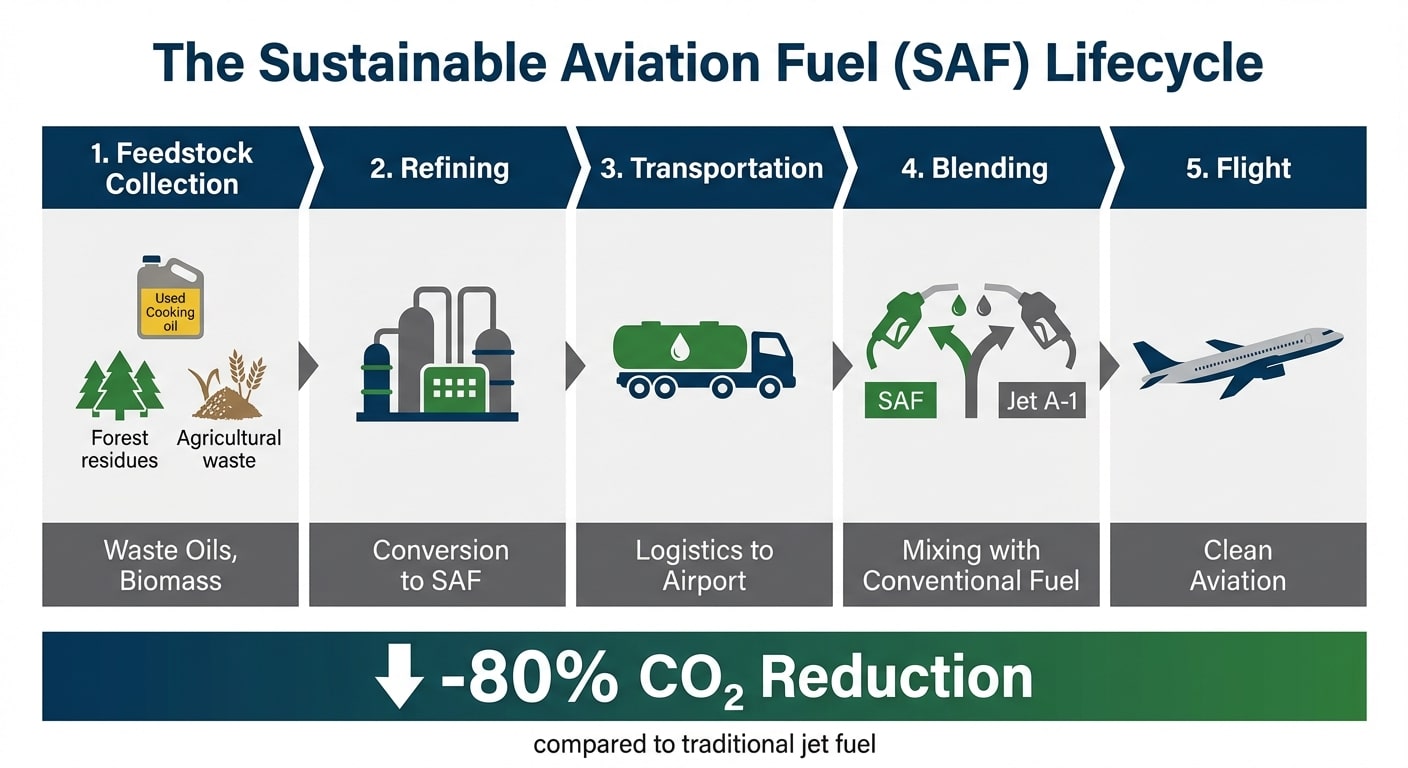
For SAF, the lifecycle picture is meaningfully different. Feedstocks like used cooking oil, waste animal fats, forestry residues, and agricultural residues either come from biological materials that absorbed CO₂ during their growth, or from waste streams that would otherwise decompose and release gases anyway. This is why lifecycle carbon emissions for SAF can be reduced by up to 80% relative to petroleum-based jet fuel across equivalent fuel volumes.
According to the International Energy Agency, international aviation emitted around 800 million tonnes of CO₂ in 2023. Without mitigation, that number rises sharply as passenger demand grows. SAF is the aviation sector’s primary tool for bending that curve downward in the near term, before new propulsion technologies reach commercial scale.
What SAF Is Made From: Feedstocks and Renewable Resources
One of the most important dimensions of the sustainable aviation fuel story is that it isn’t tied to a single raw material. SAF can be produced from a wide range of sustainable feedstocks, which matters because supply availability varies by region, season, and industrial output.
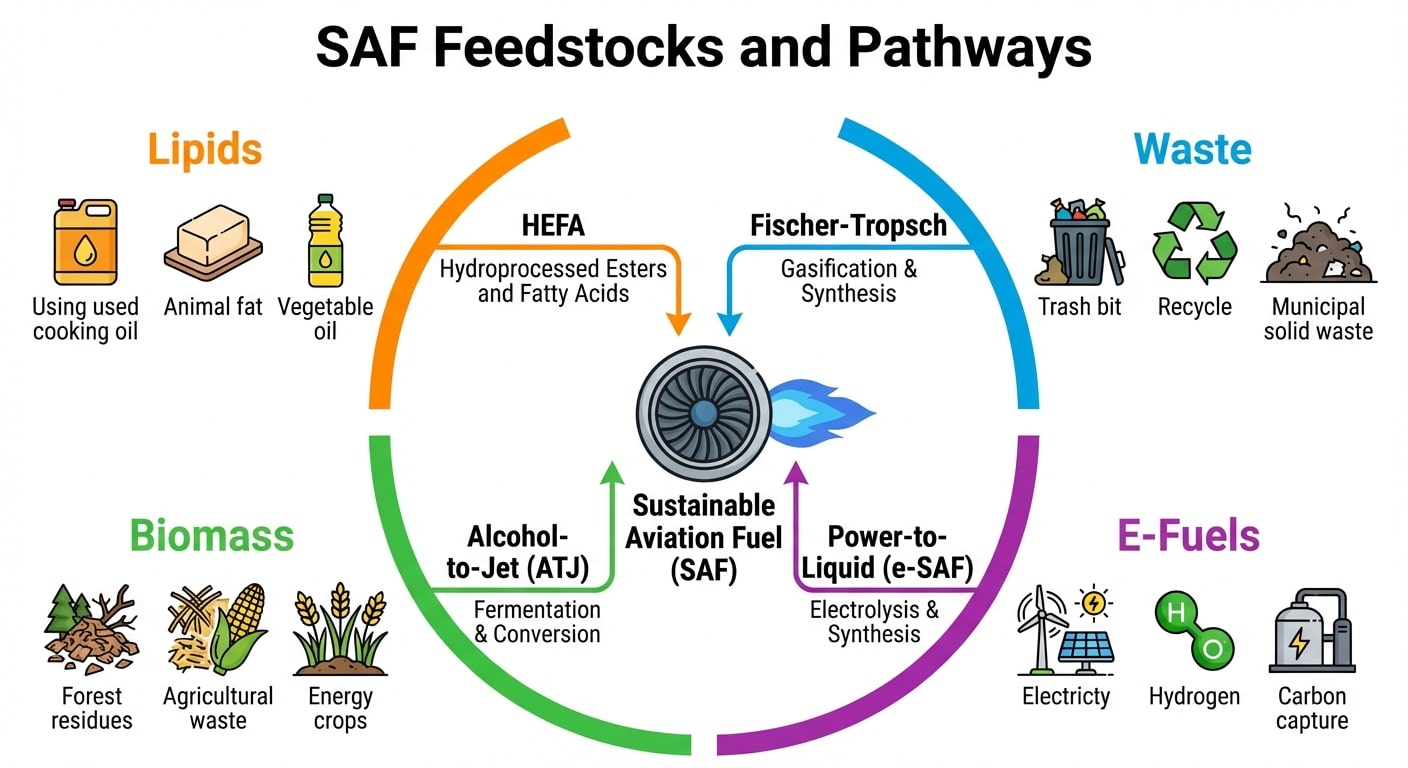
The most widely used feedstock category today is lipid-based materials. This includes used cooking oil, waste oils, waste animal fats, and vegetable oils, all processed through a production pathway called HEFA (Hydroprocessed Esters and Fatty Acids). The HEFA process breaks down fatty acids from these materials into hydrocarbon chains that closely resemble jet fuel. Approximately 82% of global SAF production capacity currently relies on HEFA technology, which makes the availability of waste oils and cooking oil a genuine supply bottleneck for the industry.
Beyond lipid-based feedstocks, SAF can also be produced from the following:
- Agricultural waste and agricultural residues, crop byproducts like straw, husks, and bagasse that would otherwise be burned or left to decompose
- Forestry waste and forestry residues, woody biomass, logging byproducts, and forestry thinnings
- Municipal solid waste, household and commercial refuse diverted from landfills, converted into fuel via gasification
- Energy crops, non-food crops grown specifically for bioenergy production, though this pathway raises food security concerns where it competes with food crops for land
- Fermented sugars, plant-derived sugars converted to alcohols and then processed into jet fuel through the alcohol to jet (ATJ) pathway
The overlap between SAF feedstocks and food production is a legitimate concern in global policy discussions. Most industry roadmaps prioritize waste streams and residues over food crops to avoid driving up food prices or reducing food security in vulnerable regions.
SAF Technologies Driving the Transition
The variety of SAF technologies available today reflects the industry’s effort to match different feedstocks with proven chemistry, and to develop new pathways that can scale to meet future demand.
HEFA (Hydroprocessed Esters and Fatty Acids) is the most commercially mature pathway. It processes fatty acids from oils and fats using hydrogen to produce a fuel that blends well with petroleum jet fuel. HEFA is cost-competitive relative to other SAF pathways, but its dependence on waste oils means it can’t scale indefinitely without new feedstock sources.
Alcohol to Jet (ATJ) converts fermented sugars or alcohols, including ethanol and isobutanol, into jet fuel blendstocks. This pathway broadens the feedstock base to agricultural residues and energy crops, and it’s recognized for its scalability and flexibility in feedstock sourcing. LanzaJet’s Freedom Pines Fuels facility in Georgia is designed to produce approximately 9 million gallons of SAF annually, representing one of the most significant commercial-scale ATJ deployments to date. Separately, Air New Zealand and LanzaJet commissioned a feasibility study showing that locally grown woody waste residues in New Zealand could be converted into SAF via ATJ technology, enough to supply up to 25% of the country’s domestic aviation fuel needs.
Fischer-Tropsch Synthetic Paraffinic Kerosene (FT-SPK) gasifies woody biomass, forestry residues, or municipal solid waste into synthesis gas, which is then converted into synthetic paraffinic kerosene. This pathway handles a wide variety of waste streams and can scale to large volumes, though production facilities require substantial capital investment and construction timelines.
Power-to-Liquid (e-SAF) is the most promising long-term pathway for deep decarbonization. It uses green hydrogen, generated from renewable electricity through electrolysis, combined with captured CO₂ to synthesize aviation fuel. E-SAF can theoretically reach near-zero lifecycle emissions, but it currently costs up to 12 times more than conventional jet fuel. Falling costs for renewable electricity and electrolyzers will determine how quickly this pathway becomes commercially viable.
Each of these SAF technologies has a role to play. No single pathway will meet the full scope of future demand, which is precisely why diversifying across feedstocks and production methods is central to every credible SAF roadmap.
Existing Aircraft and the Drop-In Advantage
A core reason SAF has emerged as the most practical near-term decarbonization tool for the aviation sector is that it works in existing aircraft. The global commercial fleet represents trillions of dollars in capital investment, and aircraft remain in service for 20–30 years. Transitioning to hydrogen or electric propulsion would require entirely new aircraft designs, new fuel storage systems, and new airport infrastructure, a process that would take decades and leave current emissions largely unaddressed in the meantime.
SAF blends can be used in existing aircraft engines today under current certification standards, with blends of up to 50% SAF approved for commercial use under ASTM D7566. In November 2023, Virgin Atlantic demonstrated the concept at its outer limit when it completed the world’s first transatlantic commercial flight powered by 100% SAF, a milestone that showed what’s achievable even with existing fuel systems.
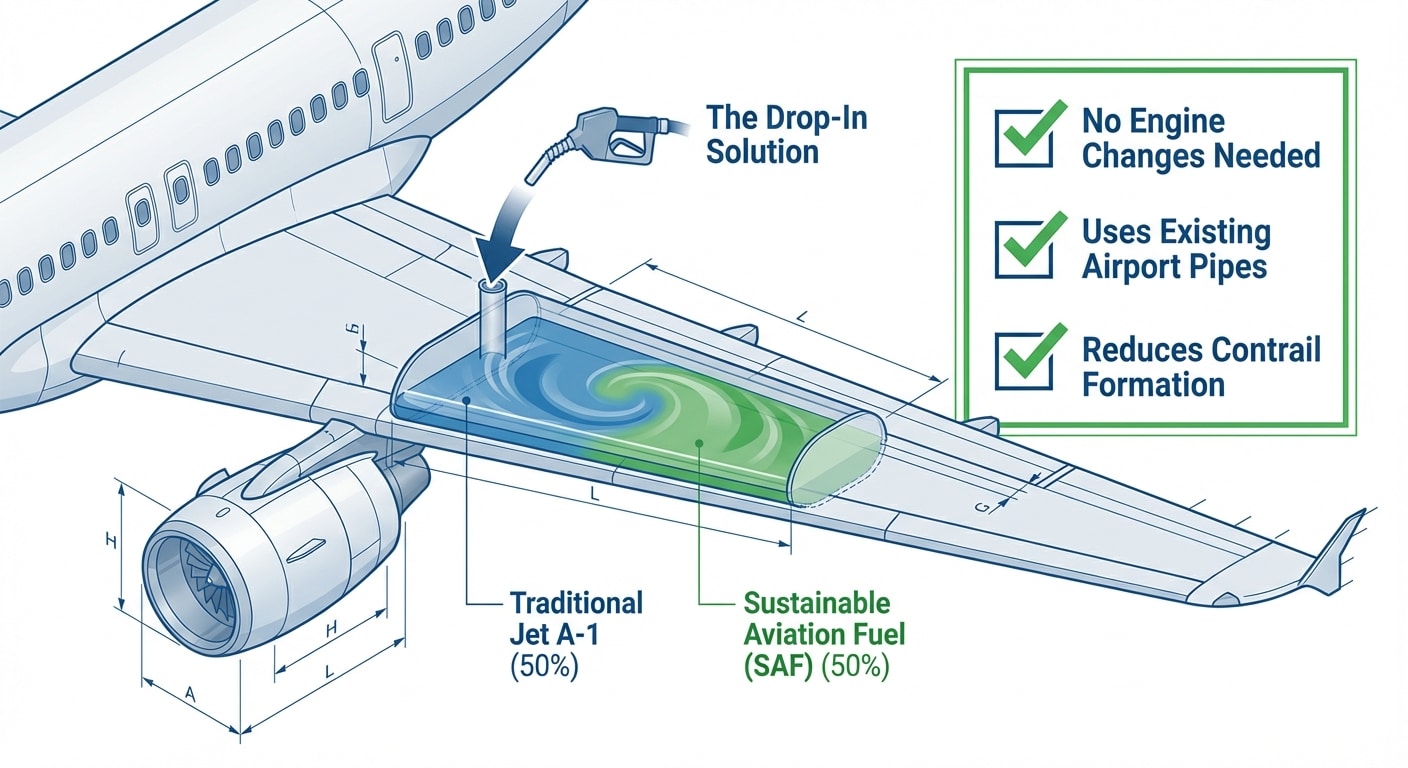
The environmental benefits of higher SAF blends extend beyond carbon. In the ECLIF3 study published in 2024, Airbus, Rolls-Royce, the German Aerospace Center (DLR), and Neste measured the in-flight impact of 100% SAF use on an Airbus A350. Compared to conventional Jet A-1 fuel, contrail ice crystal formation was reduced by 56%, a significant finding because contrails trap heat in the atmosphere and are estimated to contribute meaningfully to aviation’s total climate impact.
There is one technical constraint worth noting. SAF must contain a minimum level of aromatic components, typically around 8.4%, to maintain the integrity of seals within existing fuel systems and aircraft engines. Most SAF production pathways produce fuel that’s rich in straight-chain hydrocarbons but low in aromatics, which is why current regulations require blending with petroleum jet fuel to meet the aromatic threshold. Researchers at MIT and the University of Illinois are actively developing sustainable aromatic sources from lignin and recycled polystyrene, innovations that could eventually enable 100% SAF blends in existing engines.
Key Stakeholders Pushing SAF Adoption Forward
Scaling sustainable aviation fuel from a fraction of a percent of global jet fuel production to a dominant share by 2050 requires alignment across a broad set of key stakeholders, none of whom can succeed independently.
Airlines are the primary buyers of SAF and the organizations absorbing the cost premium over conventional jet fuel. As of 2025, approximately 60 airlines have set specific SAF targets for 2030, and major carriers have signed long-term offtake agreements with SAF producers to underwrite investment in new production facilities.
SAF producers and fuel suppliers include companies like Neste, TotalEnergies, World Energy, LanzaJet, and Diamond Green Diesel. The U.S. Energy Information Administration reports that U.S. SAF production capacity reached approximately 30,000 barrels per day in 2025, with new production facilities coming online in California, Texas, Nevada, and Hawaii.
Regulatory bodies have become the most powerful demand drivers. The EU’s ReFuelEU Aviation regulation mandates a 2% minimum SAF blend from January 2025, scaling to 63% by 2050. The UK has legislated comparable targets, and Japan is finalizing a 10% SAF mandate by 2030. The International Civil Aviation Organization (ICAO) has established a global framework to reduce the carbon intensity of international aviation by 5% by 2030 through SAF use, and all SAF used under ICAO’s CORSIA scheme must meet stringent sustainability criteria set out in the EU Renewable Energy Directive (RED), providing a baseline for how emissions reductions are measured and verified across international flights.
Governments are backing SAF with financial incentives. The U.S. Inflation Reduction Act provides up to USD $1.75 per gallon for qualifying SAF production. The UK has committed £180 million to SAF projects, and the EU has announced €1 billion in funding for industrial-scale e-fuel plants.
Government support is also expanding beyond Europe and North America. Australia’s Renewable Energy Agency (ARENA) launched a $30 million SAF Funding Initiative in 2023 to support domestic SAF production, with funded projects including Jet Zero Australia’s alcohol-to-jet facility in Townsville, Queensland. India, meanwhile, has set an indicative target of 1% SAF blending in jet fuel by 2025, rising to 2% by 2028, as part of a broader push to reduce the emissions from one of the world’s fastest-growing aviation markets.
Corporate buyers outside the aviation sector are also purchasing SAF voluntarily. Companies like Amazon, Microsoft, and DHL are securing SAF through book-and-claim agreements to reduce the carbon intensity of their supply chain logistics and business travel.
Greenhouse Gas Emissions, Carbon Emissions, and the Aviation Industry’s Net Zero Commitment
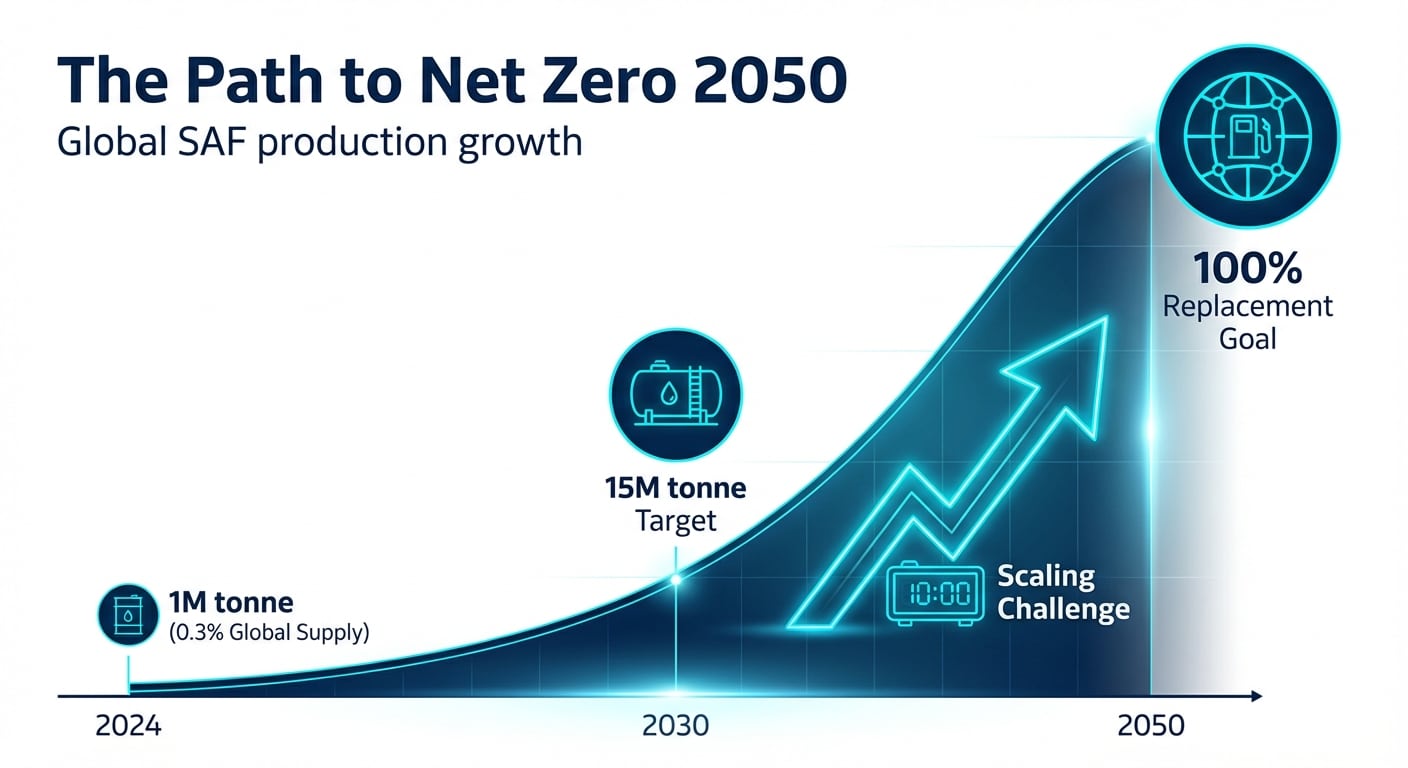
The aviation industry’s commitment to net zero carbon emissions by 2050 is one of the most ambitious decarbonization pledges in any major global sector. IATA, which represents over 360 airlines accounting for approximately 85% of global air traffic, formally adopted this target, and ICAO’s global framework gives it multilateral backing across member nations.
SAF is expected to account for the majority of aviation’s near-term emissions reductions. The U.S. Sustainable Aviation Fuel Grand Challenge targets 3 billion gallons of SAF per year by 2030, and 35 billion gallons by 2050, enough to replace 100% of projected jet fuel demand at that time. Meeting these targets would slash the aviation sector’s contribution to global carbon emissions and go a long way toward the broader goal of reducing the industry’s greenhouse gas emissions in line with the Paris Agreement.
The gap between ambition and current production makes the urgency clear. In 2024, global SAF production reached 1 million tonnes, just 0.3% of total jet fuel production worldwide. Production in 2025 is expected to reach 1.9 million tonnes. By 2030, demand could exceed 15 million tonnes, meaning the industry needs to roughly double output every year between now and the end of the decade. That scaling challenge is why accelerated SAF deployment has become a priority not just for aviation, but for energy policy more broadly.
The International Air Transport Association has been clear: meeting net zero isn’t possible with SAF alone. Improvements in aircraft fuel efficiency, operational efficiency, and the long-term development of alternative propulsion technologies all have roles to play. But SAF is the tool that can move the needle now, with the fleet that exists today.
The Challenges Facing Wider SAF Adoption
The case for SAF is strong. The barriers to widespread adoption are equally real.
Cost is the most immediate challenge. SAF currently costs two to five times more than conventional jet fuel in most markets. In Europe, where blending mandates have pushed demand ahead of supply, some fuel suppliers have charged airlines up to five times the fossil jet fuel price for SAF. IATA estimates that airlines paid a cumulative premium of USD $2.9 billion for the SAF available in 2025, a burden that ultimately flows through to ticket prices and airline economics.
Feedstock availability is the structural constraint beneath the cost problem. Because 82% of current SAF production relies on HEFA technology, global supply is effectively capped by the availability of used cooking oil, waste animal fats, and other lipid feedstocks. Scaling to meet 2030 targets requires diversifying into forestry residues, agricultural waste, and municipal solid waste pathways, all of which require new production facilities with multi-year construction timelines.
Policy design is the third variable, and arguably the most correctable. The tension between demand mandates (which create regulatory pull but can spike costs without guaranteeing supply) and production incentives (which stimulate supply without forcing immediate compliance costs) is central to the current SAF policy debate. IATA has pushed back strongly on the EU mandate structure, arguing that better-designed incentives would achieve the same emissions reductions at lower cost to airlines and passengers. Getting the policy framework right will be as important as building new production capacity.
Funding gaps for technology demonstration represent a fourth, less-discussed barrier. Scaling newer pathways like FT-SPK and Power-to-Liquid from pilot scale to commercial production requires demonstration facilities that prove technology at real-world volumes before investors will commit to full-scale plants. These demonstration projects are expensive, take years to build, and often fall in a funding gap between early-stage research grants and fully commercial investment, slowing the diversification of SAF production beyond the HEFA-dominated status quo.
Build a Career at the Intersection of Aviation and Sustainability
The SAF transition is generating real demand for professionals with skills that cross both the aviation and sustainability fields. Roles in airline sustainability management, environmental policy, fuel supply chain logistics, energy systems analysis, and aviation operations are all part of the picture as this market grows.
Everglades University offers programs designed to prepare students for careers connected to this field.
The Master of Science in Aviation Science is designed to provide aviation professionals, including flight crewmembers, air traffic controllers, maintenance technicians, and airline and airport management personnel, with advanced knowledge of aerospace technology, airline operations, aviation logistics, and contemporary issues shaping the aviation sector. The program is available completely online and at campus locations in Miami, Tampa, Sarasota, Boca Raton, and Orlando.
The Bachelor of Science Degree with a Major in Aviation/Aerospace is designed for students looking to enter the aviation industry or build on existing aviation experience. The program combines a broad aviation foundation with concentration options in areas such as safety, flight operations, management, operations management, maintenance management, security, and unmanned aerial systems, allowing students to align their studies with the segment of the industry that fits their career goals. Students with FAA certifications or military aviation backgrounds can apply prior learning toward degree completion. The program is available online and on campus.
The Bachelor of Science Degree with a Major in Sustainability is designed to equip graduates with foundational knowledge across environmental science, energy policy, corporate social responsibility, and sustainable business practices. Courses including Energy Policy, U.S. Environmental Policy and Management, Logistics, Supply Chain Management and Sustainability, and Corporate Social Responsibility and Sustainability speak directly to the policy and operational challenges shaping the SAF industry. The program is available online and at five Florida campus locations: Boca Raton, Miami, Orlando, Sarasota, and Tampa.
Everglades University is accredited by the Southern Association of Colleges and Schools Commission on Colleges (SACSCOC) to award bachelor’s and master’s degrees. The university offers small class sizes and flexible learning schedules designed to fit the lives of adult learners, career changers, working professionals, and military veterans. Financial aid is available to those who apply and qualify.
Explore Everglades University’s degree programs or request more information to take the next step.
Frequently Asked Questions
What is sustainable aviation fuel (SAF)?
Sustainable aviation fuel is jet fuel produced from renewable feedstocks, including used cooking oil, agricultural waste, forestry residues, and municipal solid waste, rather than from crude oil or fossil fuels. SAF can reduce lifecycle carbon emissions by up to 80% compared to conventional jet fuel, and it functions as a drop-in fuel compatible with existing aircraft engines and fuel systems.
How does SAF compare to conventional jet fuel?
Unlike conventional jet fuel refined from fossil fuels, SAF is produced from materials that are part of the active carbon cycle. When SAF burns, the carbon dioxide released was recently absorbed by the source feedstock rather than extracted from ancient underground reserves. SAF blends meet the same ASTM certification standards as petroleum-based aviation fuel and can be used in existing aircraft without modification.
Why is aviation so hard to decarbonize?
Battery technology can’t match the energy density of liquid fuel at the weight required for commercial flight. Hydrogen-powered aircraft are in development but require entirely new airframe designs, fuel storage systems, and airport infrastructure. SAF works in existing aircraft and existing engines today, making it the most scalable near-term solution for reducing the aviation industry’s greenhouse gas emissions.
How much SAF is being produced today?
Global SAF production reached 1 million tonnes in 2024, approximately 0.3% of total global jet fuel consumption. Production is expected to grow to around 1.9 million tonnes in 2025 as new production facilities come online. Industry projections place potential demand at over 15 million tonnes by 2030.
What are the main feedstocks used to produce SAF?
The most widely used feedstocks today are used cooking oil, waste animal fats, and other waste oils, processed through the HEFA pathway. SAF can also be produced from agricultural residues, forestry residues, and municipal solid waste through gasification, from fermented sugars via alcohol to jet conversion, and from green hydrogen via power-to-liquid synthesis.
Who are the key stakeholders in the SAF industry?
Key stakeholders include airlines purchasing SAF to meet sustainability targets, SAF producers and fuel suppliers building production capacity, regulatory bodies like ICAO and the European Commission setting mandates, governments providing production tax credits and grants, and corporate buyers securing SAF for logistics and business travel. Progress depends on coordinated action across all of these groups.